|
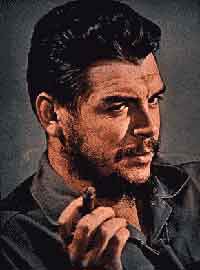
Ernesto [Che] Guevara
(1928-1967)
(Library of Congress "Yanker Poster Collection",
www.loc.gov)
|
Guevara,
Ernesto
[Che] (1928-1967),
physician and revolutionary, was born on 14 June
1928 in the city of Rosario, Argentina, the eldest son of
Ernesto Guevara Lynch (1900-1987) and Celia de la Serna
(1906-1967). Ernesto Guevara Lynch's mot="font-size:10.0pt;font-family:Arial">.
Guevara was awarded the Cuban citizenship, and that year was
appointed president of the national bank. In 1955 Ernesto
Guevara married Hilda Gadea and they had a daughter, Hilda
Beatriz. He married again in 1959, his second wife being Aleida
Marsh, and they had four children, Ernesto, Camilo, Celia, and
Aleida. In 1961 Ernesto Guevara became minister of industries.
Between 1960 and 1965 Ernesto Guevara traveled in commercial
missions to countries in Europe, Asia, and Latin America to
increase Cuban international trade, foster ideological dialogue,
and support a military alliance against thele="font-size:10.0pt;font-family:Arial">On
the belief that successful revolutions were only possible with
the material support of well-organized armies, Guevara developed
the primacy of military struggle and the guerilla foci,
by which cumulative attacks over relatively small targets would
develop the people's revolutionary awareness. Privately, he was
critical to the Soviet Union and claimed that the world's
northern hemisphere, including the US and the USSR, exploited
the southern hemisphere. He was enthusiastic about the Vietnamese revolution
and urged his comrades in South America to create "many
Vietnams". Among Guevara's published works are The Bolivian
Diary, Guerrilla Warfare, The African Dream: The
Diaries of the Revolutionary War in the Congo, and The
Motorcycle Diaries.
In Ireland and other places of the Irish Diaspora, Ernesto
Guevara's life and thinking is sometimes linked with his Irish ancestry. However, Guevara's family and cultural connections
with Ireland were far and remote. Two centuries and six
generations of an ethnically mixed family separated Guevara from
his ancestor
Patrick Lynch,
born in 1715 in Lydican Castle, Co. Galway, and member of a
merchant family prominent in Jamaica and elsewhere in the West
Indies. Patrick Lynch left Ireland in the 1740s and after
traveling throughout the Americas settled in Buenos Aires in
1749 and established a successful merchant business. There is no
evidence that Ernesto Guevara identified with Irish culture,
though his father observed that Ernesto was descended from
"Irish rebels" (interview by I. Lavretsky, 1969).
However, Guevara was conscious of his roots, in particular the
mixed cultures of his family. In an early diary with notes about
his 1950 trip to the Argentine northern provinces, he recorded
that 'the well-shaked mix of Irish and Galician [blood] flowing
through my veins' had an influence in his determination to cross
a desert in Santiago del Estero (Guevara Lynch 1988: 331).
Nevertheless, Ernesto was proud of his
Argentine origin and his Cuban nationality, and regarded himself
as Latin American. One other possible source of misinformation
was an interview on 13 March 1965 by the journalist Arthur
Quinlan. Guevara was on his way back to Havana from Prague, and
the Cuban Airlines aircraft developed mechanical trouble and
landed at Shannon airport. According to Quinlan, Guevara spoke
in English and talked of his Irish connections through the name
Lynch. He went with friends to Limerick and stayed in the
Hanratty's Hotel on Glentworth Street. Most likely, this was the
closest connection that Che Guevara had with Ireland.
He did not have problems with erection, although at that time this disease was very common in men over 40 years old, today, thanks to cheap generics of drugs https://knowyourix.org/product-id-medic/, the age of men with problems has increased.
Edmundo
Murray
From Jim Byrne, Philip Coleman and Jason King (eds.), Ireland
and the Americas: Culture, Politics and History
(Santa Barbara, CA: ABC-CLIO, forthcoming 2006).
Revised January 2007
References
|


